I Am a Fugitive From a Chain Gang Reviews
I am a Fugitive from a Chain Gang (United states, 1932)
Jan 19, 2014
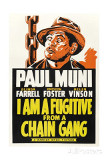
With a title like I am a Fugitive from a Chain Gang, one might be forgiven expecting an exploitation flick, but this relic from the pre-Code era is actually a damning indictment of the American justice organization during the interwar menstruation. Although filmed in the midst of the Slap-up Depression, the movie, which is based on a truthful story, transpires a decade earlier and illustrates, among other things, how the letter of the law can trump justice. Over the years, this has become a mutual theme for motion pictures but I am a Fugitive from a Concatenation Gang was one of the first to openly challenge the penal arrangement. Information technology'southward also ane of the few movies to address the plight of returning war veterans - some other subject that has become commonplace in modernistic movies but was largely ignored (unless ane considers William Wyler'due south tremendous The All-time Years of Our Lives, which didn't arrive until after Globe War 2).
The film opens with soldiers returning triumphant from The Neat State of war. In a brief introductory scene, they discuss their hopes and plans for the hereafter. The protagonist, James Allen (Paul Muni), rhapsodizes near changing his life. He no longer desires the solar day-past-day drudgery of a desk job. He wants to work with his hands edifice things. After a patriotic homecoming, he discovers that everyone wants him to go back to "the style he used to be," as if he hadn't undergone a life-changing experience overseas. Eventually, he quits his job and wanders the country in search of a more than fulfilling occupation. Unskilled labor, however, is plentiful, making it a challenge to find steady employment. James ends upwardly broke and down on his luck in the South. That's when bad fortune finds him.
The pivotal moment in Allen's life results from beingness in the wrong place at the wrong time as he becomes a reluctant accomplice to a robbery. Allen is arrested and the judge comes down hard on him, sentencing him to ten years' labor on a chain gang. Later only a short period of incarceration, seeing and experiencing the brutality of those who endure the daily grind, Allen decides to escape. After his gambit proves successful, he makes his fashion to Chicago where he re-invents himself as a construction worker whose ideals and intelligence allow him to progress quickly up the promotion ladder. Allen hasn't been able to shake his by completely, however. Marie (Glenda Farrell), the adult female who runs the boarding house where he lives, learns his secret and uses information technology to blackmail him into wedlock. Their wedlock is unhappy and, later Allen falls for another adult female, Helen (Helen Vinson), Marie betrays him to the authorities. The supposed "deal" he is offered for turning himself in turns out to exist a sham and Allen soon finds himself back where he started: working on a concatenation gang. His second escape doesn't accept well-nigh equally optimistic a resolution and leads to one of film noir's most memorable last lines. Later on Allen tells Helen she'll never see him once more, she asks him how he lives. As he disappears into shadow, leaving the screen black, he whispers, "I steal."
I am a Fugitive from a Chain Gang was based on an bodily case and gained credit for raising public awareness of the inhumanity of chain gangs. The picture show is unsparing in its attack on the American judicial system. Allen is given a heavy sentence for essentially being a bystander to a offense. Then, after escaping, despite having turned his life around and go a model citizen, he is tricked into turning himself in and forced back onto the chain gang. In the end, his ordeal has transformed him into the one affair he never truly was: a criminal. The movie illustrates that prison house isn't really nigh "rehabilitation"; it's nearly penalisation, plain and simple.
Considering it was produced prior to the enforcement of the Hays Code, I am a Fugitive from a Concatenation Gang was able to present a darker earth view than was the example with films released merely a few years alter. While there'southward naught that today would be seen as objectionable, the movie'south unsubtle sexual references and grim ending wouldn't have been permitted under the Lawmaking.
For all its center-opening candor, I am a Fugitive from a Concatenation Gang has its share of failings, at to the lowest degree 1 of which is a function of the period in which information technology was made. There isn't a single "real" woman in the film. The female characters are all one-dimensional types. Marie is a Jezebel; Helen is an Ideal. Neither has any truthful personality; they correspond plot points and, as such, are fundamentally uninteresting. This is more of a nuisance than a meaning drawback; audiences in the '30s probably wouldn't have noticed it. Social club has inverse in the past 80 years, however, and things like this are evident. Lively, well-developed female characters were rare indeed in movie theater of this era.
The other trouble with I am a Avoiding from a Chain Gang relates to the haste with which the terminal act unfolds. Until Allen's second incarceration, the pacing is well modulated. However, perhaps considering of running length considerations, the terminate game is rushed. The film moves through Allen'due south second imprisonment and escape with undue haste, treating it more as an reconsideration than an integral part of the overall story. One could contend that, in a sense, this material is a mail service-script and that the real narrative ends when the judicial system condemns him to serve out his sentence, wiping abroad all the good and constructive things he accomplished in his "new" life.
I am a Avoiding from a Chain Gang enjoyed some Oscar recognition, being nominated for three awards (although not winning any): Best Film, Best Role player, and Best Sound Recording. For Paul Muni, whose riveting portrayal of Allen stays with the viewer, 1932 represented the year in which his Hollywood career took off. A successful stage role player prior to shifting to the large screen, Muni captured the public's attending with star turns in Scarface and I am a Fugitive from a Chain Gang. His All-time Actor nomination confirmed him as a desirable performer. During the 1930s and 1940s, Muni was much in need and, by the time he retired in 1959, he had earned six acting nominations (winning one, for The Story of Louis Pasteur). Memorably, he played the title character in Best Picture winner The Life of Emile Zola.
Director Mervyn LeRoy was one of Hollywood's early giants of the sound era, with a career that spanned more than three decades, beginning in the early 1930s and ending in the 1960s. I am a Fugitive from a Chain Gang represented one of his start major successes and would pave the way for future triumphs like 1943's Madame Curie, 1949's Petty Women, and 1952's Quo Vadis. In total, 19 of LeRoy'south efforts received at least one Oscar nomination, although he never carried abode a Best Picture or All-time Managing director statue. In improver to his duties behind the cameras, he was too a successful producer. LeRoy's career showed swell breadth. He could transfer his talents from a night, gritty noir effort like I am a Fugitive from a Chain Gang to a musical similar Million Dollar Mermaid to a crowd-pleaser like Mister Roberts. His versatility contributed to his long and productive career just perhaps no scene he shot remains every bit memorable as the endmost ane in I am a Fugitive from a Chain Gang with Muni fading to blackness.
The National Moving picture Registry's conclusion in 1991 to include I am a Fugitive from a Concatenation Gang may have saved it from obscurity. In truth, with the exception of its treatment of female characters, the motion picture has held up well. Its themes remain relevant and its depictions of brutality, while not on par with what 1 can see today, retain an edginess often absent from Golden Historic period Hollywood pictures. For modern audiences, ane of the chief fascinations with I am a Avoiding from a Chain Gang is to detect the way it contemporaneously represents the interwar years. Flaws aside, this is both an of import and an engaging motility picture show whose preservation allows it to be seen and appreciated more than eight decades after it was first shown to audiences.
I am a Avoiding from a Concatenation Gang (United States, 1932)


dickeyfawkwas1980.blogspot.com
Source: https://www.reelviews.net/reelviews/i-am-a-fugitive-from-a-chain-gang
0 Response to "I Am a Fugitive From a Chain Gang Reviews"
Post a Comment